

Rose Care FUNda­men­tals – March 2022

Frank Brines

Frank Brines
ARS Master Rosarian

Boy, has it been crazy weather? Depending on your location—or more specifically, that of your garden—you may have experienced frost damage to your roses and tender young plants recently. Keep an eye on your roses: If you see that frost has actually killed new growth that came out after pruning, you may need to re-prune, making your cuts just above the next outward-facing bud down the cane.

The thing is, even gardens in the same general vicinity may have different effects due to their prevailing micro-climates. The next few days of March will be slightly above normal with predicted temperatures in mid 80s. Overall temperature predicted for March is near average. Roses enjoy this weather which encourages roses to jump into life. A regular schedule for irrigating should already have begun. Roses do love food and water for the best blooms. Rule of thumb when new growth is 2-3 inches long it is time to begin a fertilizing program.

Take time now to inspect and make any necessary repairs to your irrigation system. Drip systems are the most efficient and they avoid problems created by above-ground sprayers and sprinklers, which waste water and can foster molds (e.g., mildew and rust). If possible, avoid any over-spray or misting applied elsewhere in your garden that may hit your roses; but if you use overhead watering systems, avoid doing so when there is any wind to avoid moisture evaporating or collecting on leaves which could result is sun burn or add to conditions favorable for fugal diseases. For best results and efficiency, be sure to schedule irrigation so it is complete before the day gets hot (preferably by mid-morning, that is, 8am to 9am). Avoiding afternoon or evening watering prevents excess ground moisture into night time. Too wet soil can lead to unhappy roots and/or fungal diseases.

If your roses experienced fungal diseases last year and you haven’t yet done so, you might think of applying a lime sulfur dormant spray soon. You can mix Horticultural Oil with the dormant spray for better adherence. Read the label to make sure you can mix different sprays. As a note of future caution, be prepared for chilli thrips as temp warms up.

Steps to take when ready to spray: First, make sure the garden is free of left-over debris and to dispose it in the green garden waste bin—do NOT compost rose debris in your yard. Backyard composting doesn’t get hot enough kill any pathogens. Second, remove all old leaves that may be left on the bush. This cleanliness will help keep down disease. Third, read the spray label completely to ensure the proper strength of the mixture for “growing season instructions” as the new growth has begun. Fourth, saturate all canes and the soil surface of the entire bed. Fifth, maintain a minimum of 2″ to 4″ of organic composted mulch over the entire garden surface to insulate the upper 8″ to 12″ of the soil zone where most rose roots feed, and to reduce evaporation and conserve water, while still providing sufficient moisture. This will also supply nutrients to build the soil for your roses over the season.

You can begin fertilizing when new growth is 2″ to 3″ long. I suggest an initial feeding each year be higher in nitrogen (N) to encourage new stem and leaf growth. In about two weeks, apply fertilizer that is higher in phosphate (P) and potassium (K) to give roots a boost at start of season. New information suggests that continued use of fertilizer higher in P and K will foster greater root development and lead to better growth, disease resistance and healthier plants. Look for fertilizers rated as 8-10-8 that include micro elements for greater results.

I highly recommend organic type fertilizers vs. inorganic or “chemical” ones. Organics foster better soil development, a richer, livelier, more viable community of soil organisms that break the elements into easily absorbed form and release them slowly. They will “build” soil structure into a healthy component and when used regularly will develop a soil rich in reserve energy, allowing you to use less product with the same results.

If you have completed your pruning it is likely all your pruners need sharpened. Sharp pruners make for clean cuts and the prevention of diseases or otherwise damaged weak canes. The best files to use are thin flat types with diamond grit material. This type allows easier sharpening for the tight spaces between the cutting blade and bar. Attempt to follow the current/original bevel/angle of the sharp blade. Felco states that the angle for their pruners is 23 degrees. Keeping pruners clean can be done using 70% isopropyl alcohol,WD40 soak, or Lysol sheets. If heavy plant “juice” is a problem a small brass bristle brush will help remove it. Lubricate the mechanism with a light oil like 3-in-0ne.

There are rose shows scheduled for April 23 (at the Los Angeles Arboretum) and April 30 (San Diego Rose Society held in El Cajon).

Frank Brines
ARS Master Rosarian

I am an ARS Master Rosarian. If you would like personal answers to rose questions you can leave them on the TVRS website or email me at roseguy2000@aol.com.
Romantic Garden & Entrance Welcomes Bob & Dona Martin Roses

peace entrance

by Kathy Trudeau

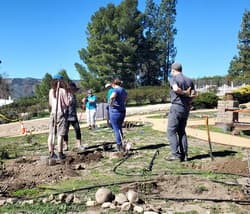
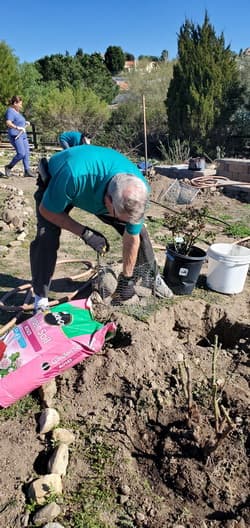
We had a hard-working crew, and we were able to dig holes, make gopher cages, and plant 19 of the Roses we adopted from Bob and Dona Martin’s Garden. This area of our garden is going to look spectacular in the spring. The three remaining Martin roses are planted next to the entrance way. The Romantic Garden is also getting ‘dressed up’ with a new pathway to match the Peace and Friendship garden.

Thank you Monique, and her two daughters Bella and Emma, Nancy and Roger, Florence, Diane, Byron and Kathy. We were also greatly assisted by Monique’s landscaper, Miguel, who was a real trooper in dealing with all the rocks.

We also appreciate all the work Jill has done turning our dirt to soil. The new roses in the Bob and Dona Martin collection by the gazebo benefited from her efforts.

How Does Our Garden Grow – March 2022

Rebecca Weersing
Rebecca

Rebecca Weersing

With the City of Temecula hosting an Urban Forest Summit in March, we should recognize that we already have an Urban Forest area at Rose Haven as well as having other trees scattered throughout the garden. When looking at the garden it seems to be almost treeless because we have constraints on the location and height of trees that can be planted in the garden. The major constraint is the huge water pipelines that bisect the garden. The pipelines, carrying water to San Diego, were built about 1943 and are 30 feet underground. Metropolitan Water District has the final word on our plantings of trees. Thus we cannot plant trees that grow over 20 feet tall. We have, so far, had to remove only one tree for exceeding the height requirements – a Peppertree that was growing near the easement road above the Dry Stream Bed.

There are other trees in this same area: Desert Willow, Mountain Mahogany, Chaste Tree and Western Redbud. The Mountain Mahogany is not a true mahogany but is so named because of the hardness and color of the wood. Mountain Mahogany (Cercocarpus) is actually a small tree in the rose family. It can be planted in all soil types including dry clay. Once established (about two years) no irrigation is required.

There are about 20 different varieties of trees on the property. When visiting the garden, take time to check out our trees.

President’s Message – Mar. 2022

Virginia Boos
President

Back

My 95th birthday is coming up next month and I’m still going strong. My thoughts – It’s important to stay active, even though some days I don’t feel like I want to do that. Staying healthy, listening to my body clues, visiting my primary doctor often and following his advice, taking my medications faithfully, are all indications that I am taking care of myself. My advice: don’t give up the battle! We have a new member who can teach Tai Chi, noted to relieve stress, as well as strengthening and stretching tired muscles; more on that to follow soon.

I’ve had over 30 years as a member of TVRS. So much has happened since our beginning. We now own a special rose garden, a beautiful well-planned place with many memories for me. Individuals have come and gone, but are not forgotten. They willingly contributed their efforts with enthusiasm. On my Peace Pole my message says “Friendships and Memories since 1990”.

How Does Our Garden Grow – Feb. 2022

Rebecca Weersing
Rebecca

Rebecca Weersing

By Rebecca Weersing

Our garden certainly grows by those who volunteer in the garden, providing tender care and feeding to our existing plants and hardscape. Our garden also grows through planning future development and redevelopment of our 24 various garden areas. Our garden is a wonderful location for educating our community about the world of gardening and volunteers are needed to help create educational programs for all ages.

Judy Sundermann is looking for individuals interested in collaborating on the publication of a booklet that would describe all of the beautiful roses in our garden. Another form of volunteering for our garden is to join the Rose Haven Committee which meets on the fourth Wednesday of every month (except July, November and December).

To volunteer in the garden, providing tender care and feeding see the article “Rose Haven Garden Volunteers” for contact information on getting started. If you are interested in planning educational programs or joining the Rose Haven Committee call or text Rebecca at 951-265-9707. To find out more about our booklet publication call or text Judy at 951-695-5251.

Our garden is constantly growing and changing. Join the process with a call or text. As Dramatist Richard Sheridan (1751‑1816) famously said “Won’t you come into my garden? I want my roses to see you”.

President’s Message – Feb. 2022

Virginia Boos
President

Back

The pruning class on January 22nd was a beautiful success. The warm sunny weather was perfect, the organization and set‑up worked well, thanks to Nancy, Kathy, Florence and Brenda. We gained 6 new members! We had hoped for a larger crowd but the pandemic situation must be keeping them away. (Who doesn’t have questions about pruning?) Some income for us came from the general donations and the raffle items, donated by Nutrien, the local Temecula garden store.

I enjoyed being the teacher once again. It’s always a pleasure to see and hear someone “get it”. One lady has 66 bushes at her newly purchased home, probably mostly Floribundas from her description, had no idea how to prune them, but now she does feel confident to start. My take‑home printed sheet of general instructions should be helpful. Another new member to mention is a 3rd generation Temeculan. She knows the history of this special place.

On another thought, the Board is pondering ideas for field trips and things we might do until Covid is under control so that we can have our regular monthly meetings. Let us know if you have a suggestion. Remember, this is YOUR rose society. Be a part of it.


Rose Care FUNda­men­tals – February

Frank Brines

Frank Brines
ARS Master Rosarian

In southern California winter is usually short and sometimes confusing. Winter for some plant life is a time of withdrawal that precedes renewal. For roses it is necessary to help them in that process. Now is the time to perform a few procedures to help reset their hormonal clock and get them ready for a great year of rose blooms. That’s the main purpose for pruning.

According to experienced rosarians, the proper time for the major annual pruning is “late winter.” This has many meanings in an area like So Cal which has numerous weather zones. Bottom line: Prune late enough to avoid risking frost damage to the tender growth that will emerge as a result of pruning. After this pruning, you can usually expect a flush of blooms 8 to 12 weeks later, depending on the temperatures during that period: the warmer it is, the shorter the time to blooms. But all things being equal, if you prune in the latter half of February you will likely have blooms in mid- to late‑April. If you want blooms for a specific date, count backwards approximately 10 weeks from that date. Pruning should be complete on this date.

In most of our region the last average frost date is mid‑March, so that means you’re probably safe pruning in mid- to late‑February. It is always a gamble and the best advice is to watch the weather. If there is winter rain during January or February, pruning can be held off awhile since these rains are cold, making the ground colder and wetter than usual.

If you haven’t began or finished pruning by now, don’t fear. There is still plenty of time to have blooms for rose shows or special spring events!

Classes of Roses

Different classes of roses benefit from different styles of pruning. To discover the class of a rose you’re working on, go to https://www.helpmefind.com/rose/plants.php and type all or part of the rose’s name to get links that best match your rose. In that information will be its class. This month’s column presents pruning techniques that work well for the first five classes described below. They are not really applicable to climbers, ground cover roses, or shrub roses: all those types have their own pruning methods.

  1. Hybrid Tea Roses (HT): You can think of these as “florist roses.” Their buds are usually borne on long stems with elegant high centers before opening, and 30 to 50 petals. If blooms are consistently removed, most hybrid teas will produce a new “flush” of blooms every six to eight weeks.
  2. Floribunda Roses (Fl): Large clusters of flowers and generally in continuous bloom through the growing season. They require less care and offer practically a hands-free experience.
  3. Grandiflora Roses (Gr): A subclass of hybrid teas but with floribunda features. They have elegant showy clusters of three to five blooms with nearly hybrid tea form and a constant growth cycle like floribundas. They tend to be larger and taller than hybrid teas.
  4. Polyantha Roses (Pol): Like floribundas but much shorter and with smaller, prolific blooms. They work well for edgings and hedges, and can be easily grown in pots. They are generally low-maintenance and relatively disease-resistant.
  5. Miniature Roses (Min): These have hybrid tea or grandiflora forms but are typically shorter and a bit more compact. Miniature roses can grow anywhere between 15 to 30 inches, whereas mini-flora roses tend to be intermediate-sized blooms closer to the size of a floribunda.
  6. Shrub Roses: These tend to sprawl from 5 to 15 feet in every direction, producing abundant clusters of blossoms. There are many subcategories, including the “David Austin English Roses.” Note: To prune shrub roses, cut them back to conform to the space you want them to fill, inspect and clean out dead and diseased material from the center, shorten canes and remove about one third of the growth.
  7. Groundcover Roses: Also called “landscape” roses, these are low‑maintenance and well suited as space fillers. They sprawl outward but reach no more than three feet tall, are generally disease‑ and pest-resistant, and bloom continuously.
  8. Climbing Roses: These are not a class, but more of a description, that is, there are grandiflora or floribunda climbing roses. They can’t actually “climb” like vines, but they produce long, sturdy, upright and sometimes arching canes which can grow up to 15 feet, going beyond a trellis, fences, arbors or pergolas. They tend to produce more flowers when grown horizontally rather than vertically.

Getting Your Tools Ready

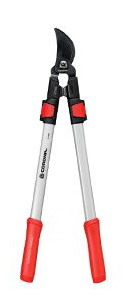
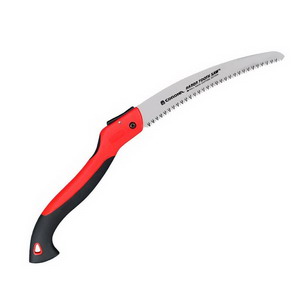
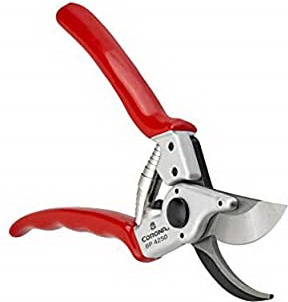
Before you prune, get your equipment in good order. Ideally, you will have gloves with arm protectors, a long handle lopper, a hand-held pruning saw, and a pair of sharp clean “bypass” hand pruners. The standard hand pruner is good for one‑inch diameter cane, the loppers and saw for anything thicker. (Using too small a pruner on too large a cane can damage the cane and “spring” the pruner so it doesn’t produce a clean cut.)


Bypass Pruners

What does “bypass” mean? Compare your pruners to the image shown above: Bypass pruners have a sharp cutting blade (which slices through the cane) and a dull curved non‑cutting blade (which holds the cane in place during the cut). The sharp blade “by passes”, or over shoots, the dull curved blade. This is in contrast to an “anvil” pruner which has a straight blade that comes down on a straight bar.

Follow these steps to get your tools ready:

  1. Lubricate the moving parts with a little light oil (such as 3-in-1 oil), and make sure they operate without resistance.
  2. Clean all tools with rubbing alcohol before and during the job. It helps prevent transmitting diseases from plant to plant and you can use it as first aid for punctures and scratches to your skin.
  3. Sharpen each blade with a small diamond file (available at garden centers), trying as much as possible to match the original bevel of the blade. Every 100 cuts or so, swipe the file over the blade a few times to keep it sharp. If you notice that your pruners are crushing the stems and/or leaving a “tail” (a small strip of tissue sticking up from the cut) then it’s past time to sharpen them!

Gross Pruning

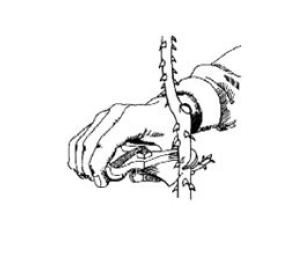
For all cuts, orient your pruners or lopper so that the non‑cutting blade is in contact with the portion of the cane that will be removed, and the cutting blade is on the side of the cut that will remain on the plant. (See “Blade Orientation” below right.) This will make more sense when you are actually holding the pruners and getting ready to cut!

A word of caution when gross pruning: Look for the small nests of hummingbirds, as this is the nesting period for two varieties in our area. Also, if you discover praying mantis egg cases on any branches you remove, find a place to put them where they will be undisturbed and hatch out so you can benefit from the offspring!

  • In Southern California our rose bushes can grow quite large, so start with some gross pruning to bring the project down to size. I use loppers to cut every bush down to about 3 – 4 feet high.
  • Next, remove all the leaves from the plant and discard into green waste bin. This removes diseased material and helps you see the structure clearly.
  • Use your hand pruners or loppers to remove canes that are twiggy, dead, crossing other canes, or passing through the center of the plant.

Fine Pruning

After removing all that stuff from the interior of the bush, you’re ready to do your fine pruning. Apply these guidelines:

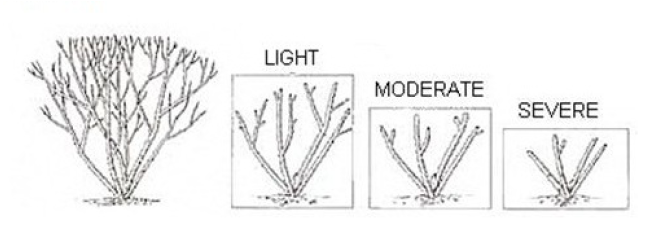
  • Prune each cane down to a height you feel comfortable with, likely between 12″ and 24″ tall. (See “Pruning Styles” image below.)
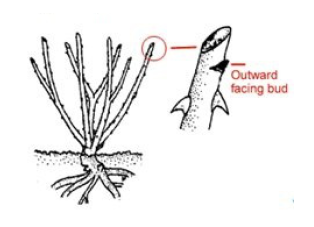
  • When pruning a cane, make an angled cut about half an inch above an outward facing bud. (See “Outward Facing Bud” image below.) This ensures that the stem grows away from the center of the plant. Note that there are always one to three buds wherever a leaf met the cane; outward-facing buds tend to be about 4″ apart. If you prune lightly to moderately—that is, if you keep your canes a little longer rather than shorter—and if frost damages the tender young growth, then you can still re‑prune to the next bud down.
  • Attempt to end up with a domed top to the degree possible so the plant will bush out in a pleasing, balanced manner.
Pruning Styles
Pruning Styles
Outward-facing Bud
Outward-facing Bud

Clean and Feed

  1. Clean the ground thoroughly of all rose debris and dispose of all cuttings and other materials in your green waste bin and put it on the street: Do not compost it!
  2. Asses the irrigation system for any needed repairs while there is no new growth and mulch has not been spread.
  3. Apply a dormant spray to the plants and the soil surface to ward off diseases. Then apply 2″ to 4″ of composted mulch to cover the entire garden area.
  4. The first fertilizing will be when new growth is about 2 inches long. I recommend lower values of the three elements (Nitrogen [3], Phosphate [4],K Potassium [3]) with slightly higher value for Phosphate.
  5. Two weeks later, begin with heavier feeding every 2 weeks for great blooms or at least monthly.

Frank Brines
ARS Master Rosarian

I am an ARS Master Rosarian. If you would like personal answers to rose questions you can leave them on the TVRS website or email me at roseguy2000@aol.com.
January 2022

President’s Message

by Virginia Boos

It’s a new year, with new hopes and dreams, new ideas, and a new Board and officers. Don’t hesitate to make your thoughts known to us. We have already discussed many plans for the future. We are motivated and hope you will join us with your own enthusiasm.

A member directory for 2022 is in my plan and we will be offering an orientation session for new members to acquaint them with our organization and committees, as well as our history. This is an important issue and we would like your input with ideas to make this successful. Contact a Board member to tell us what would be helpful to you.

Our time away from personal contact has been difficult, but the technology is now available so that we may be able to hold hybrid meetings, allowing 3 options. In person at the library, GoToMeeting at home and a big screen at Rose Haven Heritage Garden could be the choices. Stay tuned!

We need to get acquainted and feel comfortable again. When there is a chance, say “Hello”, pop a big smile and take a moment to introduce yourself. We all appreciate that human connection.

The list of opportunities to work with YOUR rose society is endless. So don’t be hesitant, we can use your help. It’s needed and very welcome. We are all partners in this effort. Sending a HAPPY NEW YEAR greeting.

Peace & Friendship Garden Fundraising Campaign Update: Extended to 1/31/2022

by Kathy Trudeau

We’re so pleased to share that we are 62.5%, $7,000 donations and commitments ($500 each), toward our goal of 24 in the ‘Sponsor a Peace Pole’ donor level. Even better news is there is still time for you, a loved one, or friend to be part of our unique international Peace Pole campaign. Additional donations in Peace Planters and Friends of the Garden are getting us closer to installing new irrigation lines and planting new roses and companion plants.

Please see our link online, sign up, and make your PayPal donation. It couldn’t be any easier to support our Garden.

How Does Your Garden Grow?

by Rebecca Weersing

LAST JANUARY 2021 I wrote: “During January we will be firming plans and estimates for three areas that will be rehabilitated during the year. The three areas are the newly defined ‘Peace and Friendship Garden’, the ‘Romantic Roses Gazebo Garden’, and the ‘Tree of Life’. We hope to be ready to start these projects after the Labyrinth Courtyard project is completed in February. We would like the projects to be finished before the heat of summer. The ‘Tree of Life’ needs to be completed by September when we hope to resume our “Families in the Garden Programs” plus initiate a Members-Only Community Garden within the ‘Tree of Life’. More details will follow as planning progresses.”

It is time to reflect on what we achieved during 2021 and how what we achieved (or didn’t) impacts our plans for 2022. In January 2021 we planned to be completed with the Boos Courtyard Labyrinth Project by February. However it was late April before the project was complete, just in time for our May Garden Days Community Events.

So the other three 2021 projects were pushed back.

(1) A small group of volunteers headed by Monique Wright worked diligently in the “Tree of Life” (To:) throughout the remainder of 2021 – attacking weeds with cardboard & mulch. repairing & replacing a number of the planting containers, contemplating a new herb garden within the ToL. Alas, because we needed to concentrate on the ToL garden infrastructure and hard-scape, we were not able to resume our “Families in the GardenPrograms”.

(2) During late summer we began in earnest to finalize and implement the plans for the “Peace and Friendship Garden” (P&F). The work related to installing the pathways is complete. Between now and the end of March we have holes to dig, roses to plant, irrigation to install, mulching to be done, Peace Poles to erect and money to raise.

(3) The “Romantic Roses & Gazebo Garden” will require some pathways similar to those in the P&F Garden, pink roses to be transplanted from other areas of the garden, the old gazebo dismantled, a new gazebo to be erected, updating of the plant material and irrigation below the gazebo and, of course, fundraising.

Our desire is to have all of these projects completed by the end of April in time for our May Garden Days Community Events.

If you would like to be part of the planning for any or all of these projects email me at rosehavencommittee@gmail.com.

As you can imagine not all of our projects proceed without some glitches but with the vision and persever­ance of our Board, our Officers, our Rose Haven Committee and all of our dedicated volunteers we have all helped in the creation of a lovely, welcoming garden.

President’s Message – Jan. 2022

Virginia Boos
President

Back

It’s a new year, with new hopes and dreams, new ideas, and a new Board and officers. Don’t hesitate to make your thoughts known to us. We have already discussed many plans for the future. We are motivated and hope you will join us with your own enthusiasm.

A member directory for 2022 is in my plan and we will be offering an orientation session for new members to acquaint them with our organization and committees, as well as our history. This is an important issue and we would like your input with ideas to make this successful. Contact a Board member to tell us what would be helpful to you.

Our time away from personal contact has been difficult, but the technology is now available so that we may be able to hold hybrid meetings, allowing 3 options. In person at the library, GoToMeeting at home and a big screen at Rose Haven Heritage Garden could be the choices. Stay tuned!

We need to get acquainted and feel comfortable again. When there is a chance, say “Hello”, pop a big smile and take a moment to introduce yourself. We all appreciate that human connection.

The list of opportunities to work with YOUR rose society is endless. So don’t be hesitant, we can use your help. It’s needed and very welcome. We are all partners in this effort. Sending a HAPPY NEW YEAR greeting.