Volunteers Needed at Rose Haven

It’s that time of year when Rose Haven Garden needs volunteers to help with the task of pruning and fertilizing our many roses.

If you are interested, we will give you direction on which areas of the garden pruning is needed. And if this is your first time to volunteer, we will give you guidance on proper pruning techniques.

We would love to have you join us! Call or text Kathy Trudeau @ 602-391-5161, Monique Wright @ 909-200-9668, or Nancy Fitness @ 602-615-1246.

Last Call – Blooming Roses

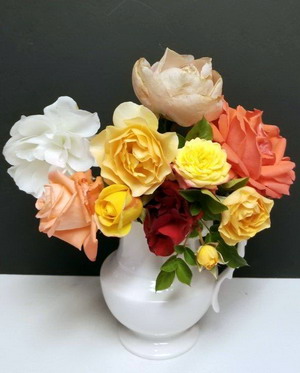
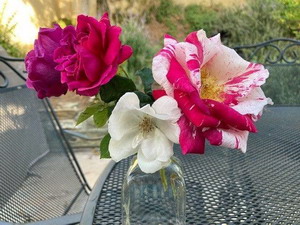
Wenlock (red), Tigress (striped), and Sharon's Delight (white) in a vinegar jar "vase."

Despite best efforts to get our roses dormant and making rosehips to get ready for pruning, many of us had gorgeous blooms from the warm January weather.

Ann Schryer’s garden was still producing beautiful blooms: Wenlock (red), Tigress (striped), and Sharon’s Delight (white) in a vinegar jar “vase.”

Wenlock (red), Tigress (striped), and Sharon's Delight (white) in a vinegar jar "vase."
Roses

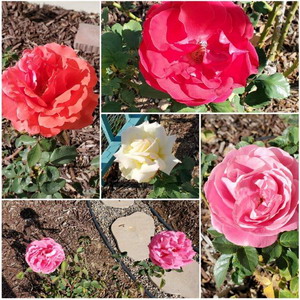
Linda Freeman had an array of January bloomers: Tiffany, Tropicana, Julia Child, Gold Medal, Miniature Yellow Sunblaze, Showbiz, NOID pink tree rose and White Iceberg.

Kathy Trudeau’s garden was also blooming with Fragrant Cloud, Veterans Honor, Peace, Pink Peace and All Dressed Up

Roses

Soil Farming at Rose Haven

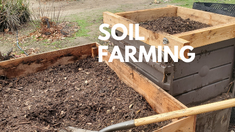
Let’s get scrappy! Turning our kitchen plant based waste, weeds, lawn clippings and organic matter into rich compost soil is happening!! All of us should be putting our plant-based food scraps into compost, either in green bins supplied by the waste carrier, our own yard or in buckets to drop at Rose Haven’s Soil Farm. If you want to be part of the solution to pollution, and donate your scraps to the process of sequestering carbon, and growing soil, contact Jill here.

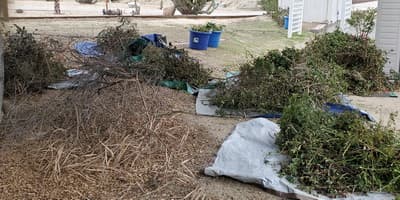
We started building compost in mid‑June. After collecting weeds, pond plants and scum, trimmings from Tree of Life and elsewhere, as well as buckets of food scraps from people who took the time to drop them off, turned it all into rich compost soil that is now being used in the Peace and Friendship plantings.

We’re experimenting with grass clippings and sawdust compost and have various methods happening in different areas, but the main project is Hot Composting (layering and cooking) in the soil farm section at Rose Haven Heritage Garden, to the right of the entry from the parking lot. Another method to turn hard dirt into loosened soil is to cover it with mulch. The little bugs and microbes show up and get to work to loosen and feed the dirt under the mulch and bring it back to life.

Did you know “…thermophiles were among the first living things on this planet. Estimated at 3.6 billion years old, they are said to be so abundant as to comprise as much as half of all living things on the planet.” The Humanure Handbook calls these thermophilic microbes our “Universal Ancestors”. These little guys show up and work hard to cook the organic material into a rich blend of nutrients that will feed our plants.

How Does Our Garden Grow – April 2022

Rebecca Weersing
Rebecca

Rebecca Weersing

To quote John Cage’s approach to getting something done: “Begin Anywhere”. This has definitely been our approach to our Youth Gardening Programs over the last 20-some years. There have been years with sparse programming and years with no programming and years with very successful programming. Some years we have done our programming with many of our members and some years we have collaborated with members of the Temecula Valley Garden Club and some years just one or two people carry the program and some years we are dormant due to circumstances beyond anyone’s control. But every year we are dedicated to finding ways to encourage our youth in discovering the joys of nature.

We have had the most success with our Youth Gardening Programs when we have dedicated people available to plan the programs and dedicated people available to work those plans. Are you someone who is interested in planning programs and dedicated to the delight of executing those plans? If so, please join us at Rose Haven on Wednesday, June 1, 2022 at 9:30 a.m. for our first “Begin Anywhere” Youth Gardening Programming Meeting. We will review our past, decide on our present, and welcome the future.

Email me at rosehavencommittee@gmail.com with your thoughts, suggestions and comments. We are going to “Begin Again” in our effort to “Begin Anywhere”.

President’s Message – April 2022

Virginia Boos
President

Back

It’s been 2 years since Covid-19 entered our lives, changing everything. Now we are trying hard to create an atmosphere of “belonging” again. I hope everyone will feel welcome to attend meetings and activities. We have big plans and are eager to see them happen.

There are so many opportunities to volunteer at Rose Haven, working outdoors and getting some exercise. May Garden Days will be coming along soon, with a whole week’s worth of interesting events and fun times to share. I’m offering my garden at home for a tour on Saturday, April 23rd, just like we have had in the past. There are plenty of activities to enjoy, if you feel like it. And I hope you will!

Soil Management

soil

by Ronald G. Schwerdt
3019 N. Major Ave. | Chicago, IL
Email: rgschwerdt@aol.com

Are your roses growing as well as they can? There may be many reason why they are not performing as they should. Some problems have simple solutions, while others are a bit more complex. Many are physiological and not related to infectious diseases or plant pests. Most arise with the plant’s environment, such as the soil. Too much or too little water, poor drainage, insufficient soil aeration, or a nutrient deficiency, etc. may be the cause. These are conditions that need to be identified and eliminated in order to grow healthy roses.

It is a well-known fact that insects and diseases thrive on stressed and unhealthy plants. Start with a biologically active soil rich in humus. Under proper conditions of moisture and soil temperature, most species of soil organisms in the process of decomposition produces substances such as antibiotics, enzymes and trace elements that provide optimal plant growth, also help fight off diseases, resulting in a natural immunity for the plants – before insects or diseases can get established.

Not all problems related to unhealthy plants are caused by environmental conditions. Some problems can be traced to various insects that inhabit the soil, such as nematodes, fungus, gnats, etc. They can feed on plants’ roots and spread diseases showing symptoms similar to plant dehydration, and yet not be caused by a lack of moisture in the soil.

While rosarians will agree that water is of the utmost importance for growing roses, so is proper soil management. Part of this “management” is conserving soil moisture for as long as possible, by any and all means. The best method of conserving moisture is to incorporate organics regularly, like sphagnum peat moss or compost, to build up a live healthy soil. This results in improved soil aeration as well as improving the tithe (workability) of the soil. Opening up the soil for greater air infiltration makes for quicker decomposition of organic matter. This organic material feeds the soil’s active microorganisms as it decomposes, thereby building the soil structure, ensuring a constant supply of nutrients and humus, which acts as a reservoir for storing soil moisture.

During hot, dry periods, with a breeze, the loss of moisture will be greatly increased. Having a limited root system and large top growth during these hot dry periods causes some plants to dry out quickly. Plants sometimes lose more moisture through the leaves, than the roots are able to absorb from the soil, causing a temporary wilting of foliage. Water, along with dissolved nutrients, are pulled upward by capillary action under tension. Moisture flows from the roots through the xylem tubes to leaves, where it evaporates into the atmosphere (leaf transpiration), producing a cooling effect in hot weather. As long as the capillary action remains unobstructed, the plants receive an adequate supply of water. Repottimg a plant in an incompatible soil may result in a break of continuity of gravity’s pull of water by the roots.

Soil is the key to growing healthier roses. A garden soil is nothing more than a combination of rocks, worn down over the years by nature, into various-sized particles. These particles, from silt to coarser sand to very fine sand are combined with a various amounts of organic matter, such as peat moss, decayed leaves, etc.

There are basically 12 recognized types of soil structures that make up the physical structure of a soil, with the percentage of sand, silt and clay determining the class. These are light, medium, and heavy soils, depending on the degree of air infiltration, water and nutrients absorption. A basic formula is one third coarse sand, one third clay, and one third decomposed organic matter. When mixed together, these elements provide a soil mixture that is light and friable, doing what you want it to do. This is known as loam, and is what you should try to change your existing soil to, if need be.

A light soil is generally sandy. While providing excellent drainage and aeration, light soil also warms up quicker in spring; it is often on the acid side; and it lacks the ability to retain moisture or nutrients. To overcome these problems, a large amount of organic matter must be worked into this kind of soil.

The soil structures in many areas are clay or silty clay loam – a heavy soil. This makes it ideal to absorb and retain moisture and nutrients, but it suffers from poor drainage. To correct the drainage problem of a heavy soil (which you must do to get oxygen down into the root system), you must work in coarse sand (torpedo) and decomposed organic materials.

These facts stated, it becomes apparent that a medium-type soil structure is best – one which incorporates only the best features of clayey and sandy soils into one that is fertile, and well balanced. Any soil can be conditioned into one that will produce healthy roses by incorporating into it what the soil is lacking. Do not try to condition a soil that is too wet to work. All you will do is compact it, making it extremely difficult to condition afterwards.

Fall is often the best time to condition the soil, as there is still sufficient time to incorporate anything required to improve the soil , letting it mellow over the winter months for next year’s spring growth.

Soil aeration is necessary for soil’s microorganisms to function properly. This is vital in the utilization of plant fertilizer as they feed on the organic matter as they condition the soil. Over a period of time this organic matter is depleted and needs to be replenished. The more chemical fertilizer used, the quicker this will happen. For this reason, it is a good practice to incorporating some organic matter into the soil every year. Without these organisms and enough organic matter for them to feed on, any fertilizer you give your plants will be of little value.

You should have a professional soil test made at least every four years, sooner if you have problems with the roses. During the growing season, check the soil’s pH yourself. Soil testing kits and meters are available that are easy to use. Even though there are indications that the soil is lacking in a certain element, the element may be present in the soil, but because it is locked up by a too high or too low pH, it is unavailable to the plant. Adding fertilizer to a plant suffering poor growth is of little use unless a soil is first conditioned to a level where the plant can take up and utilize the available nutrients. The pH in a soil is commonly referred to as the acidity/alkalinity balance. On a scale of 0 to 14, 7 is neutral. Above 7 is alkaline, below 7 acidity. For roses, the pH range should be between 6.0 and 7.0, with 6.5 ideal.

Sulfur is usually used to lower the soil’s pH, while dolomite lime is used to raise it. Dolomite lime is also a source of calcium and magnesium. The quantity to use to raise or lower the pH to the desirable range is on the box. Claims are made by many rosarians that Epsom salts (magnesium sulfate) agricultural grade encourages basal breaks. There is a great percentage of sulfur (S) 12.9 percent in a 50# bag, and magnesium (Mg) 9.8 percent. If you already have a soil on the acidity side, adding sulfur will lower your pH further! Be wary of the ashes from some types of briquettes used for outdoor cooking. While many are a source of potash, some contain a high level of sulfur. This, when combined with water, forms sulfuric acid, which again lowers the pH of your soil.

Gypsum (calcium sulfate) does not change the soil’s pH and has the ability to loosen up a heavy clay soil. Soils high in excessive amounts of sodium salts sustain damage to their structure. Having an alkaline condition can cause the plant leaves to burn. Adding gypsum provides calcium that replaces the sodium in the soil’s structure. This breaks the sodium’s bond, allowing water to flush out the soil’s salt buildup from too much chemical fertilizer.

It is important to understand the relationship between water, soil and maintaining the proper soil pH. Make adjustments if need be, and when the new rose season is in full swing, take inventory of how the roses are performing in this new changed environment. If rose are still not up to your expectations, what are the problems? Is new growth stunted and puny looking, or are blooms or foliage of abnormal size?

Do you have healthy looking foliage, but no flower buds? How about color of the bloom? Are they washed out and faded looking, instead of deep vivid colors? Are leaves lime green or yellowish (chlorotic) color instead of the dark green which is normally associated with healthy foliage? Maybe something is missing or not being utilized in the soil.

There are times when a plant may show signs of a nutrient deficiency even after being fertilized. These signs include a lack of color in the blooms, stunted plants, some leaves turn light green, white, dull gray, yellow, etc. All these symptoms can be caused by a lack of one or more trace elements (not all fertilizers contain trace elements.) A trace element can provide a plant and the soil bacteria with a balanced nutrition. When using a trace element, only a very small quantity is necessary.

One example of a nutrient deficiency occurs when trace elements are used up in the soil, causing the leaf to turn yellow while the veins of the leaf remain green. This condition usually occurs when there isn’t enough magnesium which the plant uses to manufacture chlorophyll in the soil. Yellow leaves (chlorotic) are a good indication the plant has some type of a physiological problem, a nutrient deficiency, or a problem with the plant’s environment.

While there are many reasons that cause leaves to yellow, their symptoms can be confusing. Often leaves look like the discoloration could be caused by a shortage of several different elements.

A nutrient deficient plant is plagued by insects and diseases more often than a healthy plant.

This article was provided to the TVRS as a courtesy by the American Rose Society.
A Buggin Your Garden

aphids

R.O.S.E.
Responsible, Organic, Simple, Earth-Friendly
by Jack Shoultz, Chair
668 North Pierce Street • El Cajon, CA 92020
Email: organicjack@cox.net
Website: www.OrganicRoseCare.org

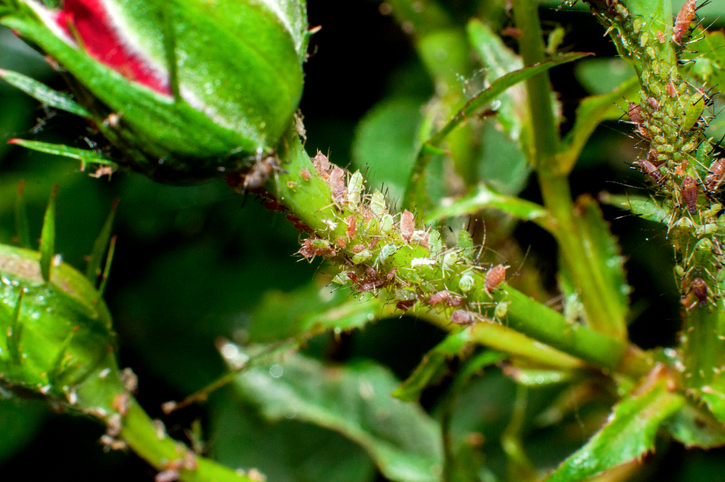
One of my most memorable moments in gardening was the first time a green lace wing fluttered out from a rosebush. This sight seemed to be one of those times when what you are doing is validated. I had been working on returning my yard to as natural a process as I could. I had thrown out or given away all the “chemical” products that had accumulated over a three‑ to four‑year period. I was even beginning to doubt the methods I was presently using because my results were not exactly what I wanted.

My roses had been looking good for a while, free of the major diseases like mildew and rust, but my insect population seemed very one sided. I was water blasting as often as I could while working swing shift or graveyard, whichever it was at that time. But it seemed that the aphids were back as fast as I knocked them off. So it was a thrill to see the luminous green wings fluttering through the garden, bringing me one step closer.

Since then I have enjoyed watching a procession of insects come and go throughout the seasons. I soon learned that buying a cup of ladybugs from the nursery and expecting them to stick around to take up residence is wishful thinking. But I did feel good about setting them free, and I am sure that someone’s garden benefited. And sometimes a few did hang out for a while.

But from my experiences came the knowledge that beneficial insects will not take up housekeeping where there is not a ready food supply. That is part of the paradox of Mother Nature. The ladybugs are not waiting in hiding for an unsuspecting aphid to appear. They are out searching for them. The aphids upon reaching your garden somehow, as if my magic, set up base on the new growth and start doing what they do best.

When you first notice the aphids, they may already have more then a generation in the area. The reproduction of aphids is a remarkable example of how one female can produce thousands of offspring in early spring. The rate, if not kept under control, can really damage a plant. (This procreative process is characteristic of many insects that attack roses.)

By now you are asking yourself, “Where are the beneficial insects to control these damaging insects?” They are checking out the neighborhood and as soon as they find a food source they will settle in. By the time the “good bugs” arrive, you may already have what you might consider an infestation, and, realistically, damage could be done before your garden environment can balance itself. The new “good bugs” arrive, but will need time to have young to help get the large number of pests under control. Spraying with chemicals will not help, as you are killing the good as well as the bad, and when the next batch hatches out, the pattern starts all over again.

So what can you, as an organic gardener, do to help? The first method of defense I use is water blasting. This is the simplest and least offensive control there is. There are many good tools to use, but I made my own blaster and it fits my needs. I don’t like bending over to get on the under side of the leaves at the bottom of the bush, which is usually where a lot of the bugs are hiding or laying their eggs. So, I took a 3- to 4-foot length of 1/2-inch PVC pipe (depending on how tall you are), attached a connector for a garden hose to one end with plumbers glue. On the other end, I attach a fitting for an irrigation nozzle. I use a 90° nozzle. That way I can focus the spray where I need it, and it gives a strong enough blast to do the job. (Email me if you need better details, but this one should cost about $10 to make.)

This method of knocking off the bad bugs will help keep them under control until the good bugs can catch up. Becoming familiar with all the bugs in your garden – good and bad – will help you know what plan of action will best help. (I only had to water blast once this spring before my garden reached balance.)

Most of us know what ladybugs, green lace wings and aphids look like, but can you identify the green worms that are eating your buds or lacing the leaves? A ladybug lays about 20 yellow, oval-shaped eggs in clusters, usually on the underside of leaves. When it hatches, the “alligator-shaped” larva is black with orange spots. Its size grows from a few centimeters at birth, eating itself up to 1/8 inch. At this stage, the larvae are consuming aphids, scale and other soft-bodied insects for 12 to 14 days. They then pupate to the adult and continue eating.

I recently saw a green worm on a rose bud, but on closer inspection saw no damage, and it was not eating the bud. I took a digital photo, went home, downloaded the image, did a Google search and found that what I had observed was the larvae of a hover fly (Syrphidae).

On looking at the image on my computer, I realized that this “green worm” had a yellow stripe on its back. Although the fly feeds mainly on pollen and nectar, the larvae can consume hundreds of aphids in a month. I confess that in the past, I had squashed some of these, mistakenly thinking they were another “bad” green worm. So not all is as it seems in nature.

To assume, that just because it is a little green worm it is bad, is not necessarily true. I learned a very important lesson from this and am now taking more pictures and doing more searching. I don’t judge a bug by its outward appearance. In fact, I have a picture of a little red worm that I am searching out now. There actually is another fly that is a predator, and that is the tachnid fly, and there are probably a lot more than I am aware of.

But, there are those other green worms such as the “rose slug.” This pest is the larvae of the sawfly and damages your rose leaves, leaving them looking lacy with a cellophane texture. Because it looks like a worm, many people spray chemical sprays they use for caterpillars, only to realize that it doesn’t work. The fairly recent discovery of Spinosad has been a great boost for anyone needing help in combating this green worm. Spinosad is man-made and a bacteria and is deemed a good product by organic standards. Spinosad works on all chewing insects, but make sure to spray the underside of the leaves. One caveat is that it will stun honey bees if sprayed directly on them, so the best thing to do is avoid spraying when the bees are most active (early morning and early evening ). I know of two products utilizing Spinosad. Green Light has one in most nurseries. Rosemania has Spinosad under the name Conserve. I have used them and find that both work. (There may be more sources in your area.) Since it only affects chewing insects, there is no damage to the beneficial insects. (If any of you have tried this product against the Japanese beetle, please let me know your results. The bad part about this is that they still have to ingest it to be effective, so there will be some damage. If it can slow the population, it may be of benefit.)

In my garden, I grow many types of butterfly- and bird-attracting plants. When the small finches make a pass through my garden a twittering, fluttering and generally raising a ruckus, I watch them go up and down the roses just eating away. When they are done and moved on, the silence means there are less bugs then before. Birds do not make a noticeable impact in any war on bugs, but anytime I see one with a grass hopper in their beak, they get a thumbs up from me. Just enjoying the music they make, the grace of their flight, the fights at the bird feeder, and watching them raise their young make me appreciate more my methods of gardening. Many butterfly larvae have voracious appetites, but generally don’t bother roses. Instead, they will choose their host plant. Spraying your roses would not really affect them as long as “they” follow the “rules.”

Of course, there are exceptions, as in the cabbage loper or moth. This small white moth, with a black spot on its wings can be seen cavorting in many gardens now. They flutter around and lay an egg here and there to allow the larvae their own leaves to destroy and generally mess up any plant they hatch out on. They can be controlled with general applications of Spinosad, about every two weeks. Or, as soon as you see the start of damage, you can apply Spinosad or try picking them off or squashing them.

The method and regularity depends on the level of damage you will accept. Which is basically what organic gardening is all about. With the new earth-friendly products we have, it is a choice as to how much you want to do to achieve your acceptable results. One result, I couldn’t accept was being stung by a wasp or yellow jacket. I normally don’t bother them as they are good for the garden. Well, this day my wife was washing off the front of the house and, without knowing it, hit one of those paper wasp nests and they took out after her. I came around to see what was going on, and they came after me. One got under my glasses and stung me about 1/2 inch below my eye. Needless, to say, that nest is gone. I discourage their nest building if they are in an undesirable area, but I still have respect for wasps and bees and what they do.

There is a family of wasps called parasitic wasps. They search for a host insect – such as aphids, white flies, scales, leaf miners and caterpillars – and lay their eggs in or on the body. When the egg hatches, it kills the host, as it is their food source. These wasps are of various sizes, but are rarely seen.

Any discussion on life in your rose garden wouldn’t be complete without mentioning spiders. I think everyone knows that spiders do a lot in the ecosystem of balancing out nature. I’m not crazy about walking out in the morning and running into a web full face, but their value far outweighs the down side.

There are more living parts to a garden, but realizing what are good and how they help makes letting them exist an integral component of your reaching that balance. This can be achieved by a little patience, ingenuity and knowledge. I hope that sharing my experiences with you will bring about more interest in finding out what good guys you have in your garden.

This article was provided to the TVRS as a courtesy by the American Rose Society.
What Are Stomata Cells?

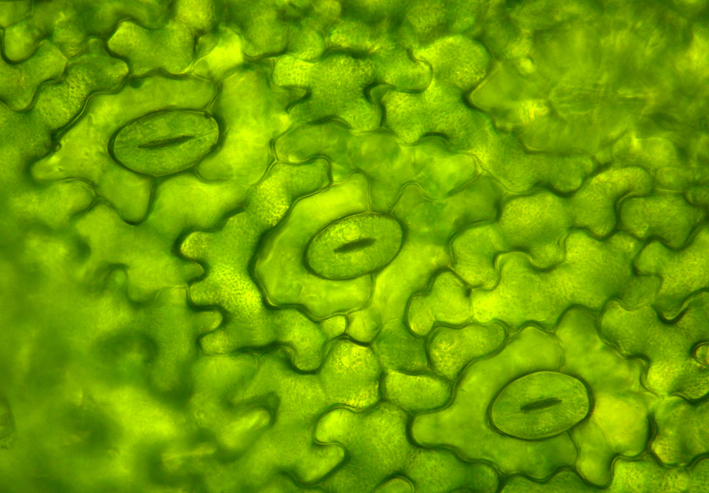
stomata under a microscope

stomataby Dr. Gary A. Ritchie • 8026 61st Ave. NE • Olympia, WA 98516
Email: rosedoctor@comcast.netImagine for a moment that you are a nanoperson who can crawl inside a rose leaf. What would it look like? What would it feel like? What sorts of structures would you see?

Above you there would be masses of green, tightly packed cells arranged in palisades. At mid‑leaf, where you are, the cells become loosely packed with large air spaces between them. The surfaces of these cells are wet to the touch. The air is very damp – 100 percent relative humidity in fact. Throughout this labyrinth of cells you see complex systems of pipes running to and from each cell. Some (called xylem) are filled with water, while others (called phloem) are filled with a sugary solution. These are the leaf veins that ultimately connect the cells to the rest of the plant.

Below you is a dark green carpet of thin, tightly interconnected cells – the epidermis – which is covered on its outside by a thin layer of wax called the cuticle. Scattered across the epidermis are thousands of tiny windows leading to the outside world. These windows are the stomata. In previous articles we’ve mentioned stomata in several contexts, but have never discussed them in any detail. Here we will explore what stomata do and how they work.

The main thing stomata do is to open and close. When they are open, gases inside the leaf, such as water vapor, carbon dioxide (CO2) and oxygen, diffuse out of the leaf into the atmosphere. The diffusion of water vapor from the leaf is called transpiration. CO2 that diffuses out is a byproduct of respiration, while the oxygen that escapes is a byproduct of photosynthesis.

Correspondingly, CO2 from outside the leaf can diffuse into the leaf, providing your rose with the carbon it needs to make food. This exchange of gasses is absolutely critical – without stomata plants could not live, life on Earth would cease, and the stock market would tank.

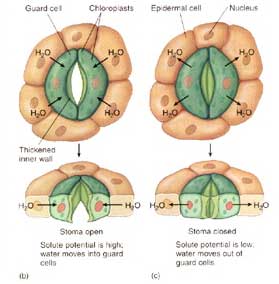
The stomatal pore is not actually a structure in itself. Rather, it is a space created when two cells, called guard cells which are embedded in the epidermis of the leaf, become either turgid (filled with water) or flaccid. The drawing at right shows how this happens. The guard cells are shaped like tiny kidney beans. When they are flaccid there is no space between them – i.e. the stomate (singular of stomata) is closed. But when they are pumped full of water, they stretch and pull apart in the middle, forming a pore.

Ideally, it would be advantageous to plants if stomata were always open. This would allow transpiration and photosynthesis to proceed continuously.

Transpiration is important because it pulls nutrient ions up into the plant, and it cools the leaves on hot days. Photosynthesis is important because it produces food. So, for the plant to gain both nutrients and food the stomata must be open. But this is problematic, because when stomata are open transpiration sucks water from leaves, causing them to dehydrate. When leaves dehydrate, stomata close blocking the uptake of CO2. So the plant must strike a balance between absorbing CO2 while not depleting its internal water balance.

To realize these conflicting objectives, hundreds of millions of years of plant evolution have created an exquisite array of interacting mechanisms and feedbacks. These control and optimize stomatal movement. For example, stomata close in darkness and open in light. The logic for this is clear – photosynthesis requires light. Stomata close when the leaves begin to dry. Again, this is a mechanism that preserves leaf moisture and prevents dehydration. They also close when humidity is low and when the CO2 concentration of the internal leaf atmosphere is high.

Stomatal opening and closing are modulated by what is know as a “potassium pump.” Potassium ions (K+) contained in the guard cells influence their osmotic properties. As the K+ concentration increases, the cell osmotic potential drops. This pulls water into the guard cells, opening the stomata. This active process accumulates potassium ions against a concentration gradient. Therefore, it requires that the plant expend energy.

An amazing discovery was made recently relating stomata to global climate change. Plant physiologists found that stomatal frequency (number of stomata per unit of leaf area) is directly related to the ambient atmospheric CO2 content – as CO2 increases, stomatal frequency decreases. Paleobotanists (kooks who make their living studying plant fossils) can use this relationship to reconstruct ancient CO2 profiles. First, they determine the age of fossil leaves, then they count their stomatal frequency. The more stomata that occur on the leaves, the lower the atmospheric CO2 was when the leaves were formed. This, then, provides a very long-term record of atmospheric CO2 concentrations. Pretty cool stuff.

Other interesting research conducted several decades ago involves indirect stomatal responses to the environment. Scientists found that when soil moisture begins to decline, ever so slightly, around a plant’s roots, the young root tips are able to perceive this stimulus. They then send chemical signals (hormones) up to the leaves that tell the stomata to close in “anticipation” of pending drought.

While this is a very interesting phenomenon, it’s also a great lead‑in to the next series of articles. There we will explore plant hormones – the chemical messengers that move around in plants and tell them what to do and when to do it. You won’t want to miss this, so stay tuned.

This article was provided to the TVRS as a courtesy by the American Rose Society.
A Brief History of the Rose

roses

by Charity Armstrong
BellaOnline’s Roses Editor

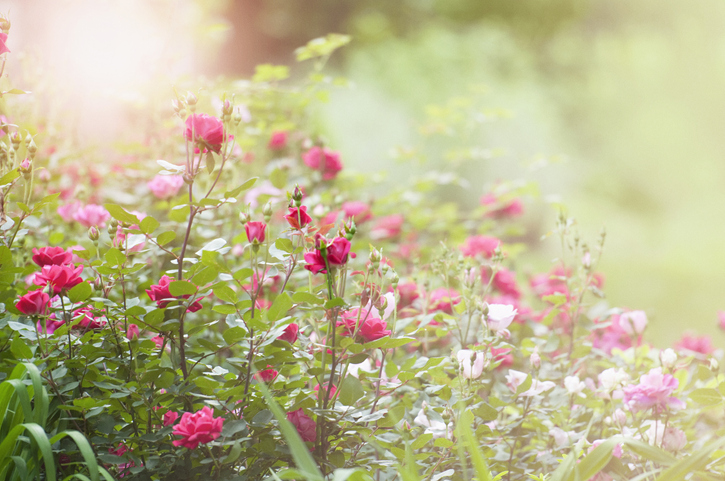
Roses today seem very commonplace. Everyone has heard of them or knows someone who has grown them. We rarely consider how they become so widespread throughout the world. How were roses originally cultivated, and why did they make it to the modern world with so many different varieties? Below is a brief history of the rose. It has taken a very long, strange, and interesting path to get where it is today.

Many people don’t realize that the roses we know today primarily originated in Asia. They were initially grown not as ornamentals, but as medicinal plants. Roses were used to treat a variety of ailments. In some Asian countries medication based on the rose plant can still be found today. Around the 16th century roses began to be exported from China by European ships exploring Asia. Europe and the Americas did have some roses, but they were primarily wild. There was little color selection, most were shrub like, and they didn’t bloom more than once a year. Roses imported from Asia were of greater quality, variety and many offered repeated blooming. The joy of tending plants that bloom throughout the growing season caused rose gardening to catch on as a hobby throughout the developing world.

Before new varieties were brought from Asia Europeans as far back as the Romans grew roses, but they were of the “old world” type. The dividing line between “old world roses” and “modern” hybrid tea roses is considered to be about 1867. From the Roman Empire until 1867 roses grew and declined in popularity throughout the world. Often only the gardening at monasteries kept roses in existence during times of decline.

Rose growing took off again in France during the 1800s when Empress Josephine encouraged rose gardening to be explored and further developed.

Empress Josephine was the wife of Napoleon Bonaparte. She resided at the Malmaison Chateau after becoming Empress of France and was extremely interested in all aspects of rose gardening. Josephine decided not just to grow roses, but to bring every single rose variety in existence to the Chateau’s garden. She worked with many important botanists and rose enthusiasts during the early 1800s to bring the roses of the world to France.

Roses hybridize very easily. In many ways this is part of what can make rose gardening exciting. There isn’t a size or color of rose bush or climbing rose that can’t be found. However, the crossing and creating of new plants has over time caused a decline in disease resistance. This is why it’s crucial to try and locate disease resistant varieties of roses for your garden.

Roses have really come a long way. They’ve basically always been around in one genus or another. In a way, rose gardening can make you feel in touch with those throughout history. The next time you’re out pruning think of the Romans tending their gardens under the ancient sun or Josephine Bonaparte in her massive rose garden surrounded by over two hundred and fifty beautiful rose varieties. She of course had an entire staff to help her prune!

© Charity Armstrong, 2007. Posted here by permission. Please join us at www.bellaonline.com/site/roses for more articles.

This article was provided to the TVRS as a courtesy by the American Rose Society.